

146599 FK
Keywords: resilience, bioregionalism, Sand Ridge, food sovereignty, food system
Principal investigator: Mihály, Melinda
Institution: ELTE Centre for Economic and Regional Studies, Institute for Regional Studies
Increasing Resilience through Bioregional Planning in the Sand Ridge (2024–2027)
In recent years, and not least in the wake of the COVID-19 pandemic, interest in alternative food systems has grown both in Hungary and internationally. This period has been characterized by the emergence of numerous new initiatives and by increasingly diverse forms of collaboration among academic, professional, and civil society organizations. The problems generated by the dominant global food system — one based on industrial production, costly technologies, environmentally harmful practices with adverse effects on local social contexts, and the concentration of control over food in the hands of a small number of multinational corporations — are becoming increasingly apparent to the wider public. There is growing recognition of the need for food systems that are more sustainable, resilient, and integrated, supported by stronger networks and more effective coordination of grassroots initiatives.
This situation calls for an integrated and integrative theoretical and planning framework capable of bringing together the diverse practical initiatives, problem definitions, policy strategies, and research projects emerging in the field of food-system transformation. Through this project, we seek to explore the potential of bioregional planning, an approach that remains relatively underdeveloped in the Hungarian context.
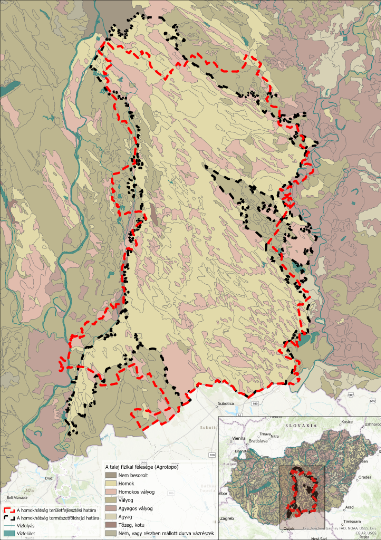
Mapping the Sand Ridge
Our interdisciplinary research, conducted by a team of 11 researchers from both natural and social sciences, investigates the Danube–Tisza Interfluve (Sand Ridge) through a set of interconnected research objectives. We approach the area first and foremost as a potential bioregion — broadly understood as an ecoregion that can also be conceptualized as a sociocultural unit. The bioregional approach provides a framework through which we can:
- conceptualize nature and society as an integrated whole, thereby contributing to the sustainable reconfiguration of their relationship;
- foster place-based identity capable of strengthening local communities in the face of the ecological crisis; and
- develop a local food system that is both ecologically appropriate and socially embedded.
Our starting assumption is that the distinctive characteristics of the bioregional approach can contribute to a more comprehensive understanding of the complex processes underlying the multifaceted ecological, socioeconomic, and political crises currently unfolding, as well as their impacts on the region. At the same time, the approach can provide a basis for developing practical tools to increase social-ecological resilience in the area.
Our research constitutes an empirical demonstration of the potential benefits of planning sustainable transitions through a bioregional lens in the Hungarian context. The Sand Ridge case also offers insights of broader European relevance, given that the ecological processes currently affecting the region are expected to expand spatially in the coming years. In the project, particular emphasis is placed on examining the relationship between bioregional planning and food sovereignty. By explicitly integrating these two fields, we aim to generate new insights into the inherently place-based nature of politics.
The project is funded under the FK_23 programme from the National Research, Development and Innovation Fund of the Ministry for Innovation and Technology.
Research Question and Methodology
A key feature of our research is that we conceptualize our analytical unit as a potential bioregion. In defining the research problem, we take the multifaceted crisis currently underway as our starting point, with particular attention to its most immediate and existentially threatening dimension: the ecological crisis, whose impacts on the Sand Ridge are already widely documented.
Drawing on these impacts, as well as on research demonstrating that lasting solutions require systemic transformation, we formulate our research questions as follows:
- How can we apply the tools of bioregional planning in the Sand Ridge?
- How may considering (and transforming) the Sand Ridge as a bioregion (or a set of bioregions) foster restorative land use and food sovereignty?
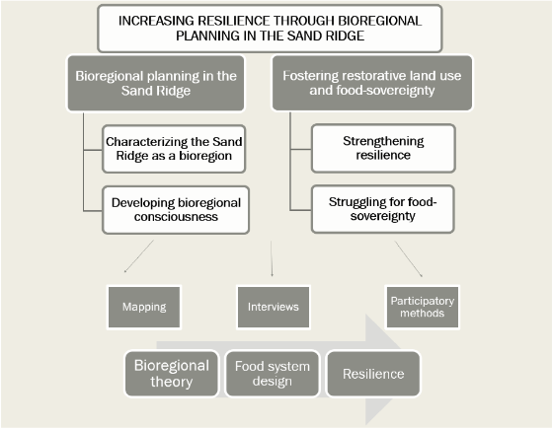
Conceptual map of the project
We hypothesize that this conceptual and analytical framing holds significant potential from both theoretical and practical perspectives. In particular, we seek to demonstrate that food sovereignty is intrinsic to bioregional planning, and that this connection can contribute to restoring and deepening local communities’ relationships with land and, more broadly, with the natural environment.
Our approach to bioregional planning places particular emphasis on the participation of affected communities. We therefore seek to demonstrate that community participation is not merely desirable but essential to the process. By examining communities’ relationships and attachments to place in depth, we aim to advance our understanding of the political dimensions of (bio)regionalism while also contributing to the long-term viability and success of transformative processes.
To establish the foundations for participatory mapping, the first phase of the research combines stakeholder identification with the collection of relevant geographical, ecological, agricultural, landscape-historical, and socioeconomic data. These datasets are analyzed using geographic information system (GIS) tools.
During the second and third phases, we conduct research in five case-study areas representing different spatial and settlement contexts, including villages, towns, peripheral areas, and centrally located areas. Semi-structured interviews are conducted with relevant experts, while life-history interviews focus on key actors involved in food sovereignty, particularly small-scale food producers.
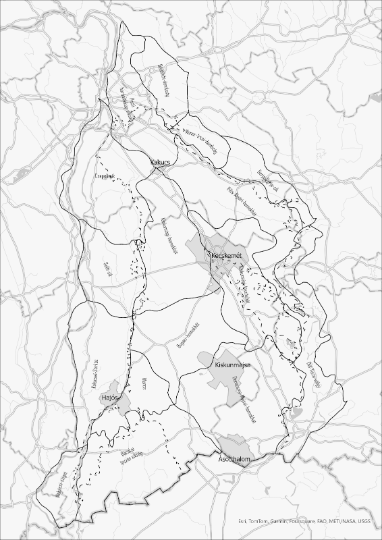
Fieldwork sites on the map of the Sand Ridge
Participatory methods are also employed in the project, including participatory mapping, emancipatory board games, and arts-based projects. Such methods become particularly central during the fourth phase, which focuses on bioregional food-system planning.
The delineation and conceptualization of the bioregion(s) will be undertaken collaboratively with stakeholders through workshops and focus-group discussions. For small-scale food producers and farmers, we seek to facilitate adaptation to the ecological crisis, including the climate crisis, through permaculture clubs, training programmes, and workshops.
A particular strength of the project lies in its emancipatory methodological approach. We do not seek to generate change solely through the subsequent application of research findings. Rather, the research process itself has been deliberately designed to raise awareness, foster dialogue, and stimulate collective action within the communities concerned. At the same time, it aims to bring together diverse stakeholders and facilitate cooperation towards the achievement of the project’s objectives.
Research Team
A major strength of the project is the unusually diverse and interdisciplinary composition of the research team. The expertise of individual team members ensures the rigorous implementation of the project’s respective research tasks, while the project’s integrative framework provides overall coherence. Transcending disciplinary boundaries — including those separating the natural and social sciences — remains a relatively rare undertaking in the Hungarian research context, despite widespread recognition of the need for such approaches.
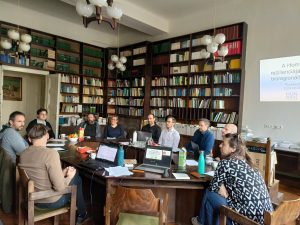
The research team established the foundations of the project during the project-launch workshop held in Kecskemét on 26 February 2024.
Balogh, Róbert, PhD (History and Political Science, University of Ostrava): He has extensive experience in the historical study of forestry and agriculture, as well as in examining the social dimensions of state-led anthropogenic landscape transformation during the nineteenth and twentieth centuries (Balogh 2018, 2022).
Gál, Izóra, PhD (Agricultural Sciences, Department of Agroecology and Organic Farming, MATE Buda Campus): Her research experience encompasses the study of organic and self-sufficient farming practices (Radics et al. 2002; Csambalik et al. 2019), as well as the environmental dimensions of different food-production systems (Velkey et al. 2021).
Kovács, András Donát, PhD (Geography, Sociology, Institute for Regional Studies, ELTE CERS, Kecskemét): He has several decades of experience researching the Sand Ridge. His research focuses on environmental challenges in urban and rural areas, the environmental systems of settlements, and the ecological dimensions of changing land-use practices (Kovács and Farkas 2019; Kovács et al. 2017).
Lajkó, Gergely (Ethnography, Doctoral School of History, University of Szeged): In addition to conducting ethnographic research in the Sand Ridge, he is a small-scale farmer in the region engaged in efforts to promote water retention. He contributes local knowledge and networks to the project.
Mendly, Dorottya, PhD (Politikatudományok, BCE, Nemzetközi Kapcsolatok Tanszék, Regionális Kutatások Intézete, ELTE KRTK, Békéscsaba, a kutatás társ-vezetője): A bioregionalizmus és a politikai elméletén szerzett tapasztalatot, kormányzás és kvalitatív módszerek fókusszal (Melegh et al 2019; Mendly 2020; Mendly 2022). A politika területisége és a politikai ökológia áll érdeklődése középpontjában.
Mihály, Melinda, PhD (Social Geography, Ecological Economics, Institute for Regional Studies, ELTE CERS, Békéscsaba; PI): Her research focuses on the solidarity economy (Defourny et al. 2021; Kiss and Mihály 2020), food sovereignty (Balogh et al. 2021; Gál et al. 2021), and participatory methods (Ádám et al. 2021; Mihály 2019a,b). She has extensive experience researching environmental and social conflicts associated with local development (Nagy et al. 2021).
Pusztai, Péter, PhD (Agricultural Sciences, Department of Agroecology and Organic Farming, MATE Buda Campus): He has research experience in organic farming and soil-conservation technologies (Patakiné et al. 2016).
Szalai, Ádám, PhD (Geography, Institute for Regional Studies, ELTE CERS, Kecskemét): Alongside urban development, his research addresses the sustainability dimensions of agricultural policy. He focuses on identifying the drivers and contextual factors underlying policy change through qualitative methods. He is also interested in the analysis of spatial data using geographic information systems (GIS) and in the visualization of research findings.
Tagai, Gergely, PhD (Geography, Institute for Regional Studies, ELTE CERS, Békéscsaba): He serves as the project’s geographic information systems (GIS) specialist (Tagai et al. 2018).
Tölgyesi, Csaba, PhD (Department of Ecology, University of Szeged): He serves as the project’s ecological expert (Tölgyesi et al. 2020).
Vasárus, Gábor László, PhD (Social Geography, Institute for Regional Studies, ELTE CERS, Kecskemét): He has experience researching the social and environmental challenges of urban–rural fringes. His work focuses on the distinctive social systems of inhabited outlying areas and their impacts on the natural and built environment (Vasárus 2016a and 2016b; Vasárus et al. 2018).
Related Resources
Publications and conference presentations related to the project
Short Films from the People in the Landscape Series
- People in the Landscape: Opportunities for Habitat Restoration in the Sand Ridge
- People in the Landscape: Small-Scale Farms in the Sand Ridge and Opportunities for Ecological Transition
- People in the Landscape: The Significance of Pastoralism in the Sand Ridge (with English subtitles)
StoryMap: Mendly Dorottya and Mihály Melinda, Building Alternatives in the Hungarian Food System (in Hungarian)
Blog: Supporting Food Sovereignty in the Sand Ridge (in Hungarian)
Facebook: Food Sovereignty in the Sand Ridge (in Hungarian)