

The study ‘Strategic coupling in the European (global?) periphery: Debrecen as an emerging location of the automotive industry’, authored by Erika Nagy, Gábor Kozma and Ernő Molnár, is now available in the new issue of Progress in Economic Geography.
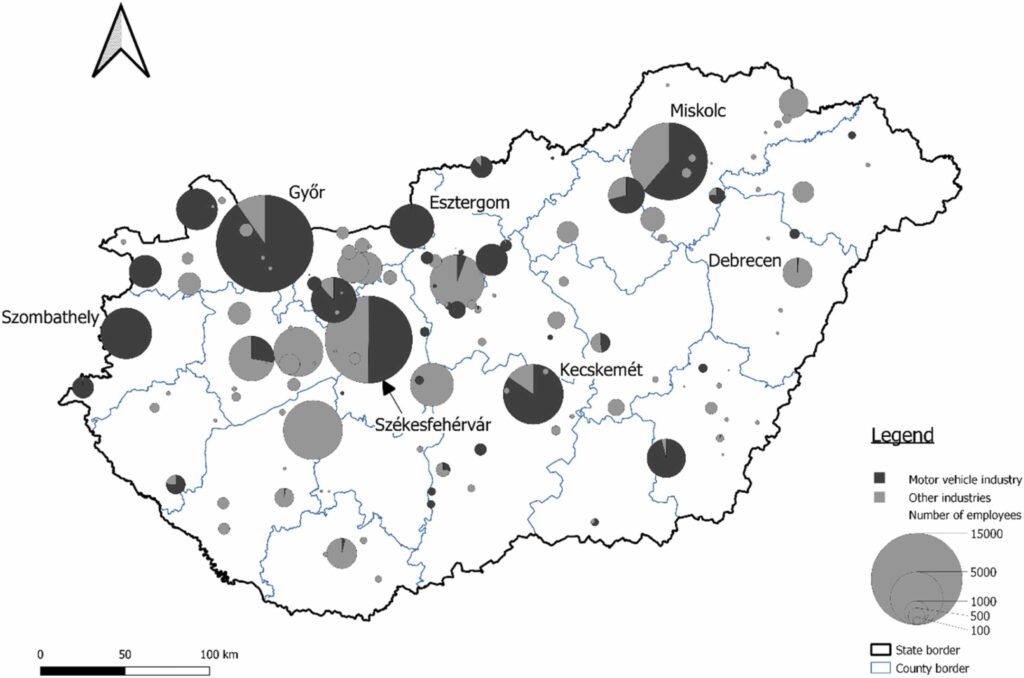
This paper is focused on strategic coupling processes of automotive production networks in the European (semi-)periphery through the lens of the cultural political economy. Adopting the case study approach and a combined methodology (interviewing, analysis of national and local development documents, press materials and statistical data), the authors reveal how Hungary’s second largest city, Debrecen, is emerging as a new location of the automotive industry in the intersection of the European and the Asian value chains. By analysing the processes of strategic coupling, the study grasps how firm (productive capital), national and local state agency are related in developing a new imaginary and how it is made hegemonic for local and national economic development. The paper unpacks how emergence of the new automotive location can be explained by the long-term location advantages of Eastern Europe and the electromobility-based industrial policy of the Hungarian government on the one hand, and the exhaustion of (human) resources in the traditional locations combined with a state policy highly prioritizing the case study city on the other. The authors also discuss how reindustrialisation emerged as a source of subjectivity by developing counter-narratives of this imaginary, and why unfolding social movements failed to articulate an alternative hegemonic vision.
The study is available online here.